Pearson Edexcel · GCSE · Psychology
Course version: 1PS0 · Version from Sept 2017
Topic 2: Memory - 2.2 Studies: *2.2.1 Bartlett (1932) War of the Ghosts
Bartlett (1932) investigated how cultural schemas influence memory using the Native American folk tale War of the Ghosts.
Checked against the Pearson Edexcel 1PS0 specification (opens in a new tab) on .
- Point 1 of 2
- 4 key terms
Study notes
From the checked teaching notes for this specification point.
The idea
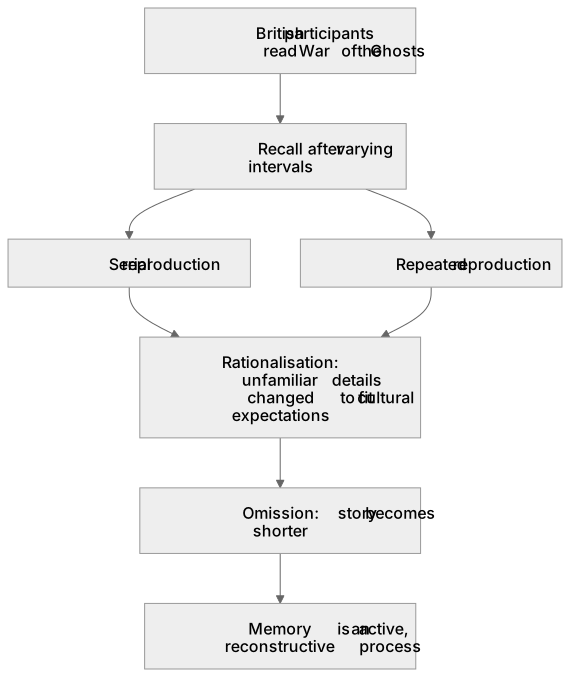
Bartlett (1932) investigated how cultural schemas influence memory using the Native American folk tale War of the Ghosts. He asked British participants to read the story and recall it after varying intervals through serial and repeated reproduction. Participants altered the story to fit their cultural expectations, a process called rationalisation (e.g. canoes became boats). The story also became shorter through omission. This demonstrated that memory is an active, reconstructive process. A strength of the study is its use of a meaningful story, offering higher ecological validity than nonsense syllables. However, a weakness is the lack of standardised instructions and strict controls, making it less scientific and harder to replicate.
What earns the marks
- Identify the aim: to investigate how memory is reconstructed when recalling an unfamiliar story.
- Describe the procedure: participants read the story and recalled it using serial and repeated reproduction.
- State the findings: participants shortened the story and rationalised unfamiliar details to fit their own culture.
- Explain the conclusion: memory is reconstructive and influenced by cultural schemas.
- Evaluate the study: a strength is the use of a meaningful task (high ecological validity); a weakness is the lack of standardised procedures.
Common mistakes and how to put them right
Believing participants intentionally changed the story.
Put it right: Participants unconsciously altered the story as their schemas automatically filled in gaps or changed unfamiliar details.
Confusing serial and repeated reproduction.
Put it right: Serial reproduction involves passing the story from person to person, whereas repeated reproduction involves the same person recalling it multiple times.
Stating the study proves memory is like a video recorder.
Put it right: The study concludes the exact opposite, showing memory is an active, reconstructive process prone to distortion.
Exam tips
- Be prepared to identify examples of rationalisation, such as changing unfamiliar cultural terms to familiar ones, in multiple-choice questions.
- Remember that Bartlett used British participants and a Native American story, which created the cultural mismatch necessary for the study.
- Link the findings directly to reconstructive memory and evaluate the study's lack of strict controls.
Try the lesson
The start of the Topic 2: Memory - 2.2 Studies: *2.2.1 Bartlett (1932) War of the Ghosts lesson, made from checked teaching notes for this specification point.
Have a go first
What was the main aim of Bartlett's (1932) 'War of the Ghosts' study?
Listen
Bartlett (1932) investigated how cultural schemas influence memory using the Native American folk tale War of the Ghosts. He asked British participants to read the story and recall it after varying intervals through serial and repeated reproduction. Participants altered the story to fit their cultural expectations, a process called rationalisation (e.g. canoes became boats). The story also became shorter through omission. This demonstrated that memory is an active, reconstructive process. A strength of the study is its use of a meaningful story, offering higher ecological validity than nonsense syllables. However, a weakness is the lack of standardised instructions and strict controls, making it less scientific and harder to replicate. A strong answer earns marks for these points. Identify the aim: to investigate how memory is reconstructed when recalling an unfamiliar story. Describe the procedure: participants read the story and recalled it using serial and repeated reproduction. State the findings: participants shortened the story and rationalised unfamiliar details to fit their own culture. Explain the conclusion: memory is reconstructive and influenced by cultural schemas. A common slip: Believing participants intentionally changed the story. Instead, Participants unconsciously altered the story as their schemas automatically filled in gaps or changed unfamiliar details. Exam tip: Be prepared to identify examples of rationalisation, such as changing unfamiliar cultural terms to familiar ones, in multiple-choice questions.
See it
Key words
Say what each word means before you turn the card.
Reconstructive memory
Try answering aloud or in your head before turning the card.
Schemas
Try answering aloud or in your head before turning the card.
Cultural influence
Try answering aloud or in your head before turning the card.
Research evaluation
Try answering aloud or in your head before turning the card.
See every definition
- Reconstructive memory
- The conclusion that memory is an active process, shown because participants altered the story to fit their cultural expectations.
- Schemas
- Cultural expectations that influence memory, as participants altered the story to fit their own culture.
- Cultural influence
- The effect of participants' own culture on recall, shown by rationalisation of unfamiliar details to fit their culture.
- Research evaluation
- A strength is the meaningful story giving higher ecological validity than nonsense syllables; a weakness is the lack of standardised instructions and strict controls.
Label the diagram
Some boxes have lost their names. Pick the right name for each number.
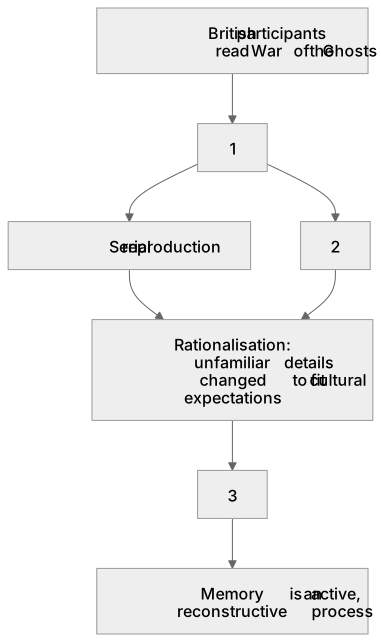
1Box 1
2Box 2
3Box 3
There is more to this lesson
The full lesson goes on to check your understanding and help you earn the marks. Create a free account to carry on, with your progress saved.
A week of Premium from your first lesson · Then the free plan continues · No card, no charge
Test your understanding of Topic 2: Memory - 2.2 Studies: *2.2.1 Bartlett (1932) War of the Ghosts
Active recall beats re-reading. Take an instant quiz now to test what you’ve learned and lock it into long-term memory.
A week of Premium from your first lesson · Then the free plan continues · No card, no charge